07 October 2026

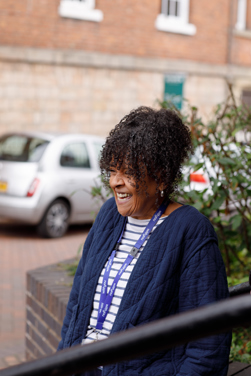
Ten years ago, on her 49th birthday, Ingrid walked through the door of Shropshire Recovery Partnership (SRP) for the first time, as a client. Today she leads the service's North team from the same office, and she says her lived experience shapes everything she does, even when she isn't talking about it.
"I hit 49 and I just thought, I cannot do this to the people that I love going into my 50th year," Ingrid says. "It wasn't due to how I felt about myself. I didn't really care what happened to me. But I really cared about my children and my family, who were going through it with me."
"I didn't do any grieving whatsoever"
It took counselling, years later, for Ingrid to understand where things had begun. The roots went back decades before she ever started drinking.
At 18, home from her first year at university, she learned that her mum had cancer and didn't have long to live. Her family told her she needed to be strong.
"I was told, you don't cry, you don't show any emotion, you need to be strong for your mum," she says. "And I absolutely took that on board and I ran with it. I cared for her. I didn't do any grieving whatsoever, because my family needed me to support them."
Her mum died that summer. When Ingrid went back to university for freshers' week, she told no one. Instead, she threw herself into work, and that coping mechanism continued for the next 30 years. She rose quickly through teaching to become an assistant head teacher, stepped back to raise her two sons, then returned to the classroom and climbed the ladder all over again.
I thought I was smashing my career, smashing the ball out of the park," she says. "But every time I took a moment when I wasn't working, all of those feelings came back. I didn't realise what I was doing and how much I was hurting myself.
Then, one morning, she couldn't go to work. The decline that followed was fast. Her marriage ended, her sons went to live with their dad, and she was caring for the grandmother who had raised her, who by then was living with dementia. Eventually Ingrid was living in one room with the curtains closed, unable to open her post or answer the phone.
"I was just existing," she says. "I couldn't engage with what was going on in my head, and the alcohol did just what I needed it to do at that time."
A smile at the door
When Ingrid first arrived at SRP, she remembers standing at the front door feeling "on my knees." What made the difference wasn't a treatment plan or a key worker. It was one of the nurses.
"Every single time she came to answer that door, she was smiling. She was warm. She made me feel as though I was welcome," Ingrid says. "And I didn't feel that from anyone else at the time. Others in my group felt the same. We all valued her very, very much."
Years later, Ingrid got to work alongside Jane and tell her what that welcome had meant. It has shaped her own practice ever since.
"The way that we greet clients, our faces and our demeanour when we answer the door, makes such a massive, massive difference."
Peace, not just sobriety
Ingrid was sober within a few months of first coming to SRP. But those early months were a daily fight.
"I was clinging to sobriety every single day. Each day was a battle," she says.
The turning point came through specialist mental health support, including grief recovery work. For the first time, she could see the pattern of her life clearly, and move beyond it.
"I knew there was a pathway out of this, that there was a possibility to have sobriety and not cling to it. To have sobriety and be at peace, and not have that constant craving," she says. "And I just thought, everybody needs a little bit of this. If I can share that with others, what an opportunity."
From volunteer to team leader
Ingrid started by volunteering at Shropshire Recovery Partnership. To broaden her experience, she then spent two years at a detox service in Wrexham, where she ran an art studio. She describes it as "a fantastic experience. I absolutely loved every moment." When a recovery worker role came up in SRP's North team, she went straight for it.
She was ambitious from her first day. "As soon as I got my recovery worker job, I was thinking, what's next?"
Three years on, she leads the team herself. She credits her colleagues with making that step up possible.
"They felt I was a safe pair of hands, and showed that they value having someone with lived experience as team leader," she says. “I have felt warmth and support every step of the way in my new role, the team have made it a very smooth transition for me which I appreciate very much."
Leading with lived experience
"I'm not someone who lives my whole life through the lens of recovery, but the skills and tools I learned along the way continue to influence the way that I think and process information. I hope that my lived experience shines out through my actions and behaviours," Ingrid says. "I'm very intentional about the way I live my life at work."
With clients who are nervous, she will sometimes share her own story. "When clients understand they're working with someone with lived experience, immediately they feel the judgement has been lifted and are able to open up.”
Her message to anyone walking through the Recovery Partnership’s front door for the first time is simple.
Many people feel, as I did, the worst they've ever felt in their whole life. My hope is that every client is met with warmth, openness, empathy and kindness. There is absolutely no judgement here. Many of us have walked in your shoes.
Full circle
Most of all, recovery gave Ingrid the chance to rebuild her relationship with her sons, now 26 and 27, who did their own work alongside her.
"That's the thing I feel the most gratitude for," she says. "I admire them very much. They both worked hard to repair the damage that my addictive behaviours caused and have shown resilience, determination and huge amounts of compassion.
Every morning, she walks the same path to the same front door she first crossed a decade ago. The wallpaper that was hanging off the office walls back then is still there, though not for much longer. She has finally persuaded the council to let her re-paper it and give the office the make over the clients and staff deserve.
"Every single day when I arrive at work, I remember the very first time I walked across the square to the office, and I think, I cannot believe this," she says.
"It's not a sense of pride, it's a sense of privilege. I'm one of the people that got that golden ticket. I constantly live in gratitude and contentment and spend a lot of my time smiling."


